




Key Takeaways
- Regular vitamin B1, or thiamine, is a water-soluble vitamin required for normal energy metabolism and nervous system function.
- Benfotiamine is a thiamine derivative that produces substantially greater systemic thiamine exposure after oral supplementation than standard thiamine salts in pharmacokinetic studies.
- Higher absorption does not automatically prove that more benfotiamine reaches peripheral nerves directly.
- Benfotiamine is converted into thiamine-related compounds that the body can use to form active thiamine metabolites such as thiamine diphosphate.
- Older short-term studies suggested possible improvements in some diabetic neuropathy symptoms, but results have not been uniformly strong.
- A 2026 12-month randomized trial found that benfotiamine increased measured thiamine metabolites but did not significantly improve the study's structural, neurophysiological, or clinical neuropathy outcomes compared with placebo.
Benfotiamine is absorbed more efficiently than standard water-soluble forms of vitamin B1. A pharmacokinetic study found that oral benfotiamine can produce substantially higher blood and cellular thiamine exposure than regular thiamine salts.
Support Your Nerve Health with SugarMD Solutions
Physician-formulated supplements made to support healthy glucose metabolism and nerve function.

However, better absorption is not the same as proven delivery to damaged nerves. Research on whether this pharmacokinetic advantage leads to meaningful improvement in diabetic neuropathy remains mixed.
Regular vitamin B1 is still an essential nutrient with established physiological functions. Higher blood thiamine levels do not guarantee nerve repair, and neuropathy can have many possible causes. Supplements may support nutritional intake, but they should not replace medical care for diabetes or neuropathy.
Benfotiamine vs. Vitamin B1 at a Glance
| Feature | Regular Vitamin B1 | Benfotiamine |
|---|---|---|
| What is it? | Essential vitamin B1, also called thiamine | Synthetic thiamine derivative |
| Solubility | Water soluble | More lipid-compatible than standard thiamine salts |
| Oral absorption | More limited at higher supplemental doses | Generally higher |
| Blood thiamine exposure | Lower comparatively | Higher comparatively |
| Converted into usable thiamine forms? | Yes | Yes |
| Essential nutrient? | Yes | No. It supplies thiamine indirectly |
| Evidence for neuropathy | Important when deficiency is involved | Studied as nutritional support, but evidence remains mixed |
| Proven to regenerate damaged nerves? | No | No |
The clearest proven difference is pharmacokinetics. Benfotiamine provides greater thiamine bioavailability after oral administration. Whether that difference produces better clinical nerve outcomes depends on the cause of neuropathy and remains an active area of research.
What Is Regular Vitamin B1?
Vitamin B1, also called thiamine, is an essential water-soluble vitamin. The body uses thiamine to form coenzymes involved in energy metabolism. Adequate thiamine is also important for normal nervous system, heart, and muscle function.
Thiamine is found naturally in foods such as:
- Whole grains
- Pork
- Fish
- Legumes
- Nuts and seeds
- Fortified cereals and grain products
It is also available in supplements, commonly as thiamine hydrochloride or thiamine mononitrate.
Because the body cannot make thiamine, dietary intake matters. Severe deficiency can affect the nervous system and may lead to serious neurological problems. In that situation, restoring adequate thiamine is medically important.
Why Do Nerves Need Vitamin B1?
Nerve cells have significant energy requirements. Thiamine is converted into biologically active forms, particularly thiamine diphosphate, also called TDP. TDP acts as a cofactor for enzymes involved in cellular energy metabolism. This matters because:
- Nerve cells depend on energy production to maintain their normal function.
- Glucose metabolism helps supply energy to nerve cells.
- Nerve signaling depends on healthy cellular metabolism.
- A true thiamine deficiency can cause neurological problems.
Correcting a deficiency is different from taking a high dose of a thiamine derivative for diabetic neuropathy. When deficiency is suspected, the priority is to identify the cause and restore adequate nutrition under appropriate medical guidance.
What Is Benfotiamine?
Benfotiamine is a synthetic thiamine derivative that the body converts into thiamine-related metabolites after absorption.
It is not a separate essential vitamin. Instead, it was developed to address some limitations of conventional oral thiamine absorption. Human pharmacokinetic studies have found greater thiamine exposure after oral benfotiamine compared with standard thiamine salts.
For a broader overview of potential uses, safety considerations, and available research, see SugarMD’s Benfotiamine Benefits and Side Effects guide.
Why Is Benfotiamine Absorbed Better Than Regular Thiamine?
Ordinary thiamine absorption in the human intestine relies substantially on specific transport mechanisms. These natural transporters can become saturated and significantly less efficient as oral supplemental doses increase.
Benfotiamine follows a different absorption pathway after initial conversion in the intestinal environment, producing far greater systemic thiamine exposure. Pharmacokinetic research confirms significantly higher bioavailability for benfotiamine compared with conventional thiamine preparations.
Does Fat-Soluble Mean Benfotiamine Goes Straight Into Nerves?
No. Benfotiamine is commonly described as a lipid-soluble or fat-soluble thiamine derivative in supplement marketing. However, that does not mean an intact benfotiamine molecule simply travels directly through body fat and immediately enters nerve tissue.
It is metabolized and ultimately increases the body's general pool of thiamine and active thiamine metabolites. While better oral bioavailability is well supported by science, directly superior delivery into human peripheral nerves is much harder to scientifically prove.
Which One Gets More Vitamin B1 Into Your Body?
Benfotiamine. A human pharmacokinetic study comparing benfotiamine with thiamine hydrochloride found substantially greater thiamine bioavailability after benfotiamine administration. Earlier pharmacokinetic research reported the same general pattern.
The process can be simplified like this:
- Regular thiamine: Oral vitamin B1 → intestinal absorption → circulating thiamine → active metabolites
- Benfotiamine: Oral benfotiamine → conversion and absorption → higher systemic thiamine exposure → active metabolites

Which One Actually Gets to Your Nerves?
Benfotiamine produces higher blood and cellular thiamine exposure than standard oral thiamine, which is why it has been studied for nerve health.
However, the human pharmacokinetic studies cited here do not directly measure how much thiamine reaches peripheral nerves.
Benfotiamine improves thiamine availability, but it has not been proven to target peripheral nerves better than regular vitamin B1.
Benfotiamine vs. Vitamin B1 for Neuropathy
1. When Neuropathy Is Related to Vitamin B1 Deficiency
If someone is thiamine deficient, restoring adequate thiamine is medically important because thiamine deficiency itself can cause neurological problems. Treatment may involve:
- Correcting the deficiency
- Identifying why the deficiency occurred
- Improving dietary intake
- Using a thiamine supplement when appropriate
- Addressing related medical or nutritional problems
Regular thiamine may be appropriate depending on the clinical situation. The correct form and dose should be determined by a healthcare professional when deficiency is suspected.
2. When Neuropathy Is Related to Diabetes
Diabetic peripheral neuropathy is different from deficiency-related neuropathy. It is associated with chronic metabolic and vascular injury, not simply a lack of vitamin B1.
Benfotiamine has been studied as an adjunctive nutritional option in diabetic neuropathy. It is not a replacement for blood glucose management, medical care, or prescribed treatment.
What Do Human Studies Say About Benfotiamine for Diabetic Neuropathy?
1. Earlier Short-Term Studies Were Promising
A small three-week randomized trial reported improvement in a neuropathy score and pain compared with placebo. The study included people with type 1 or type 2 diabetes and diabetic polyneuropathy.
Another six-week trial also reported improvement in its primary neuropathy symptom score in the per-protocol analysis. However, the intention-to-treat result did not reach conventional statistical significance, and another symptom score did not differ significantly between groups.
Studies like the BENDIP study helped create interest in benfotiamine, but they were relatively short and did not establish that benfotiamine reverses established nerve damage.
2. What Did the 2026 BOND Study Find?
The 2026 BOND study followed people with type 2 diabetes and mild to moderate symptomatic diabetic sensorimotor polyneuropathy for twelve months. Benfotiamine increased measured thiamine-related analytes and was generally well tolerated.
However, it did not significantly improve the study’s structural, neurophysiological, or clinical neuropathy outcomes compared with placebo. The findings separate higher thiamine exposure from proven nerve improvement and do not support claims of nerve regeneration or reliable diabetic neuropathy relief.
So Is Benfotiamine Better Than Regular Vitamin B1?
| If your goal is | Better supported answer |
|---|---|
| Meet normal vitamin B1 requirements | Regular dietary thiamine |
| Correct suspected vitamin B1 deficiency | Medical evaluation first |
| Maximize oral thiamine bioavailability | Benfotiamine has the advantage |
| Increase blood or cellular thiamine exposure | Benfotiamine |
| Prove nerve regeneration | Neither |
| Guarantee diabetic neuropathy relief | Neither |
| Provide adjunctive nutritional nerve support | Benfotiamine has been studied, but evidence remains mixed |
Better absorbed does not mean universally better. The right choice depends on why vitamin B1 is being used.
Why Do People With Diabetes Pay Attention to Benfotiamine?
Chronic high blood glucose can affect peripheral nerves through multiple metabolic and vascular pathways, which is part of why benfotiamine matters for people with diabetes. Researchers have studied benfotiamine because increasing thiamine availability may influence thiamine-dependent metabolic pathways.
The biochemical rationale is stronger than the current evidence for long-term clinical improvement. For people with diabetes, the central priorities remain:
- Following the diabetes treatment plan
- Monitoring blood glucose as advised
- Managing blood pressure and cholesterol
- Avoiding smoking
- Checking the feet regularly
- Seeking medical evaluation for new or worsening nerve symptoms
Benfotiamine can be part of nutritional support, but it does not replace these steps.
Where Does SugarMD Benfotiamine Fit?
SugarMD’s Benfotiamine 300 MG provides benfotiamine as a standalone supplement without a multi-ingredient formula.
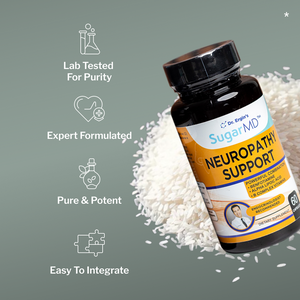
For readers looking for broader nutritional nerve support, SugarMD Neuropathy Support combines benfotiamine with vitamin B6, vitamin B12, alpha lipoic acid, acetyl L-carnitine, vitamin D3, and other listed ingredients.
Both products are intended to support nutritional intake and nerve wellness. Neither is meant to repair damaged nerves, reverse neuropathy, or guarantee pain relief.
Can You Take Benfotiamine and Regular Vitamin B1 Together?
Both supplements ultimately contribute to the body’s thiamine pool, so taking both is not automatically necessary. Before combining them:
- Check the labels of multivitamins and B complex products.
- Look for overlapping thiamine or benfotiamine ingredients.
- Do not assume that a higher intake is automatically more beneficial.
Discuss supplement combinations with a healthcare professional if you have diabetes, neuropathy, kidney disease, are pregnant, or take prescription medication.
How Long Does Benfotiamine Take to Work?
There is no evidence-based universal timeline for feeling a nerve health benefit from benfotiamine.
Blood thiamine levels can rise relatively quickly after supplementation, but biomarker changes and symptom changes are different outcomes. Short clinical studies evaluated several weeks of use, while the BOND study followed participants for twelve months.
The BOND study found increased thiamine analytes but no significant advantage in objective neuropathy outcomes after twelve months.
Can Benfotiamine Reverse Nerve Damage?
Current evidence does not establish benfotiamine as a treatment that reverses established nerve damage.
Older, shorter trials have reported improvements in some symptoms or nerve-related measures. However, the newer long-term BOND study did not demonstrate significant structural or neurophysiological improvement versus placebo.
Bottom Line
- Best for absorption: Benfotiamine
- Essential nutrient: Regular vitamin B1
- Higher systemic thiamine exposure: Benfotiamine
- Proven to reach peripheral nerves directly better: Not established
- Proven to reverse diabetic neuropathy: No
- Important when thiamine deficient: Thiamine replacement
- Studied for diabetic neuropathy: Benfotiamine
- Current clinical evidence: Mixed, with newer long-term data tempering earlier short-term findings
Benfotiamine’s strongest advantage over regular vitamin B1 is not that it has been proven to find nerves. Its strongest advantage is that the body absorbs it more effectively and achieves greater thiamine exposure.
Whether that pharmacokinetic advantage translates into meaningful nerve improvement depends on the cause of neuropathy and remains less certain.
Frequently Asked Questions
What is the difference between benfotiamine and regular vitamin B1?
Regular vitamin B1 is thiamine, an essential water-soluble vitamin. Benfotiamine is a synthetic thiamine derivative that the body converts into thiamine-related compounds.
Is benfotiamine absorbed better than thiamine?
Yes. Human pharmacokinetic studies show that benfotiamine generally produces greater systemic thiamine exposure than standard thiamine salts.
Does benfotiamine actually reach peripheral nerves?
Benfotiamine increases systemic and cellular thiamine exposure, but direct delivery into human peripheral nerves has not been conclusively demonstrated.
Is benfotiamine better than vitamin B1 for neuropathy?
Benfotiamine has a bioavailability advantage and has been studied in diabetic neuropathy. However, clinical evidence remains mixed, so it cannot be described as universally better.
Can benfotiamine reverse nerve damage?
Current evidence does not establish benfotiamine as a treatment that reverses established nerve damage.
How long does benfotiamine take to work?
There is no universal evidence-based timeline for a nerve health benefit. Blood levels and symptoms do not change on the same schedule.
Can you take benfotiamine and thiamine together?
Taking both is not automatically necessary because both contribute to the body’s thiamine pool. Check for overlapping ingredients and ask a healthcare professional before combining supplements.
Is benfotiamine the same as vitamin B1?
No. Benfotiamine is a derivative of vitamin B1. It supplies thiamine-related compounds but is not itself an essential vitamin.
Which form of vitamin B1 is best for nerve health?
The answer depends on the reason for use. Regular thiamine is important when deficiency is present. Benfotiamine has higher oral bioavailability but mixed evidence for diabetic neuropathy outcomes.
Can vitamin B1 deficiency cause tingling and numbness?
Thiamine deficiency can cause neurological problems, which may include nerve-related symptoms. New or persistent tingling and numbness should be evaluated by a healthcare professional because neuropathy has many possible causes.